
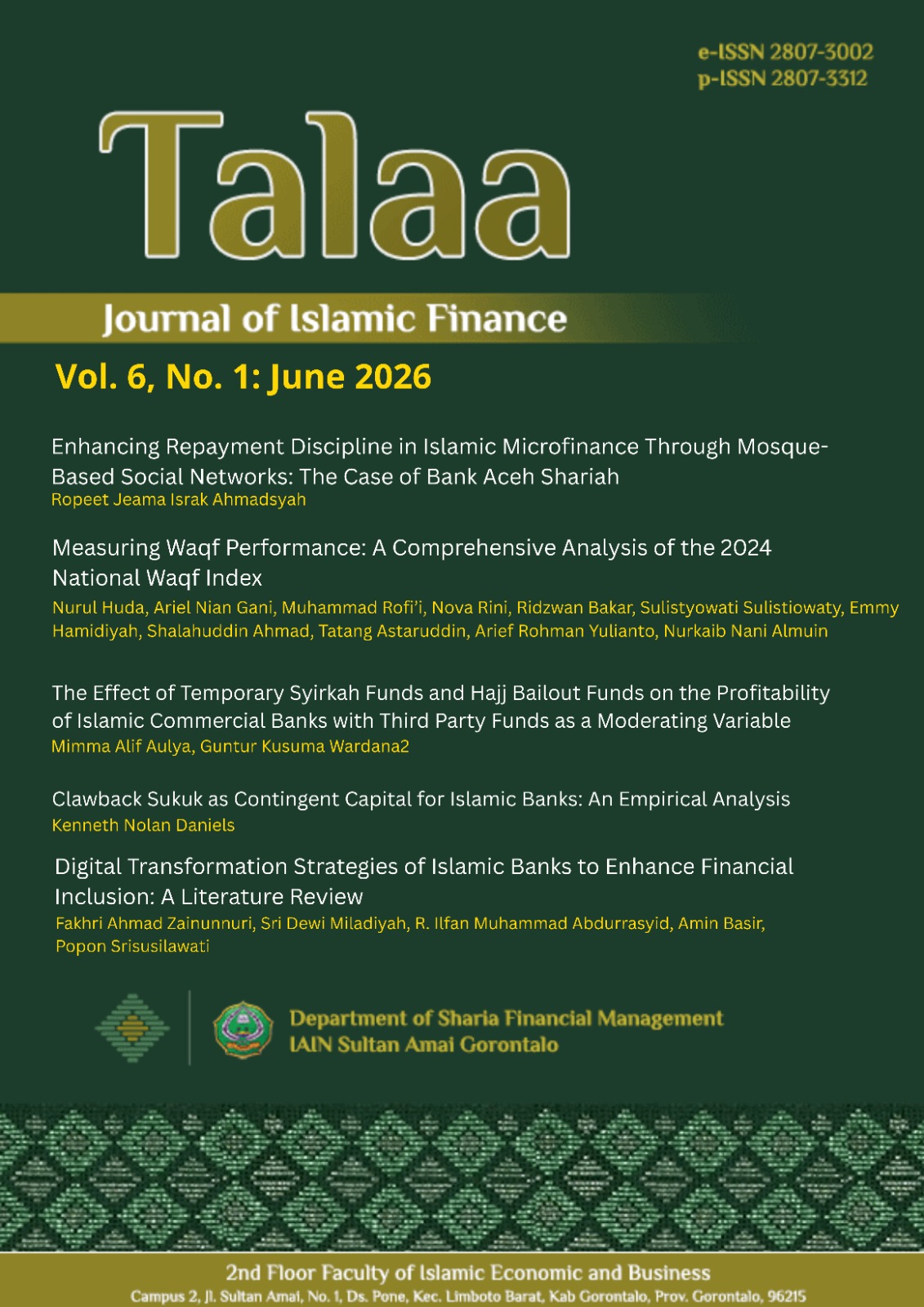
Clawback Sukuk as Contingent Capital for Islamic Banks: An Empirical Analysis
DOI:
https://doi.org/10.54045/talaa.v6i1.811Keywords:
Islamic Banks, Sukuk, Contingent Capital, Clawback Provisions, Shariah ComplianceAbstract
We extend the contingent capital framework of clawback bonds to Islamic banks under Shariah law. Using panel data on 20 major Islamic and conventional banks from 2015-2024 with 61 sukuk issuances, we find that clawback provisions reduce funding costs by 46 basis points for Islamic banks compared to only 13 basis points for conventional banks—an additional benefit of 33 basis points. This differential effectiveness stems from the natural alignment between clawback mechanisms and profit-sharing principles inherent in Islamic finance. We identify an optimal trigger level of 10-12% CET1 for Islamic banks, higher than the 7-9% optimal for conventional banks, reflecting Islamic banks' higher baseline capital ratios and lower leverage. Our findings suggest clawback sukuk should be prioritized as Shariah-compliant contingent capital instruments, offering superior loss-absorption characteristics while maintaining regulatory compliance with IFSB standards.
References
Abedifar, P., Molyneux, P., & Tarazi, A. (2013). Risk in Islamic banking. Review of Finance, 17(6), 2035-2096.
Avdjiev, S., Bogdanova, B., Bolton, P., Jiang, W., & Kartasheva, A. (2020). CoCo issuance and bank fragility. Journal of Financial Economics, 138(3), 593-613.
Avdjiev, S., Kartasheva, A., & Bogdanova, B. (2013). CoCos: A primer. BIS Quarterly Review, September, 43-56.
Beck, T., Demirgüç-Kunt, A., & Merrouche, O. (2013). Islamic vs. conventional banking: Business model, efficiency and stability. Journal of Banking & Finance, 37(2), 433-447.
Daniels, K. N. (2018). Corporate bond clawbacks as contingent capital for banks. Journal of Financial Stability, 37, 11-24.
De Spiegeleer, J., & Schoutens, W. (2012). Pricing contingent convertibles: A derivatives approach. Journal of Derivatives, 20(2), 27-36.
Farook, S., Hassan, M. K., & Clinch, G. (2012). Profit distribution management by Islamic banks: An empirical investigation. Quarterly Review of Economics and Finance, 52(3), 333-347.
Flannery, M. J. (2005). No pain, no gain? Effecting market discipline via reverse convertible debentures. In H. S. Scott (Ed.), Capital adequacy beyond Basel (pp. 171-196). Oxford University Press.
Godlewski, C. J., Turk-Ariss, R., & Weill, L. (2013). Sukuk vs. conventional bonds: A stock market perspective. Journal of Comparative Economics, 41(3), 745-761.
Hasan, M., & Dridi, J. (2011). The effects of the global crisis on Islamic and conventional banks: A comparative study. Journal of International Commerce, Economics and Policy, 2(02), 163-200.
IFSB. (2013). Revised capital adequacy standard for institutions offering Islamic financial services (IFSB-15). Kuala Lumpur: Islamic Financial Services Board.
IIFM. (2023). Sukuk report 2023. Manama: International Islamic Financial Market.
Kashyap, A. K., Rajan, R. G., & Stein, J. C. (2008). Rethinking capital regulation. In Maintaining stability in a changing financial system (pp. 431-471). Federal Reserve Bank of Kansas City.
McDonald, R. L. (2013). Contingent capital with a dual price trigger. Journal of Financial Stability, 9(2), 230-241.
Pennacchi, G. (2011). A structural model of contingent bank capital (FRB of Cleveland Working Paper No. 10-04). Federal Reserve Bank of Cleveland.
Sundaresan, S., & Wang, Z. (2015). On the design of contingent capital with a market trigger. Journal of Finance, 70(2), 881-920.
Additional Files
Published
How to Cite
Issue
Section
License
Copyright (c) 2026 Kenneth Nolan Daniels

This work is licensed under a Creative Commons Attribution-ShareAlike 4.0 International License.


.png)


