
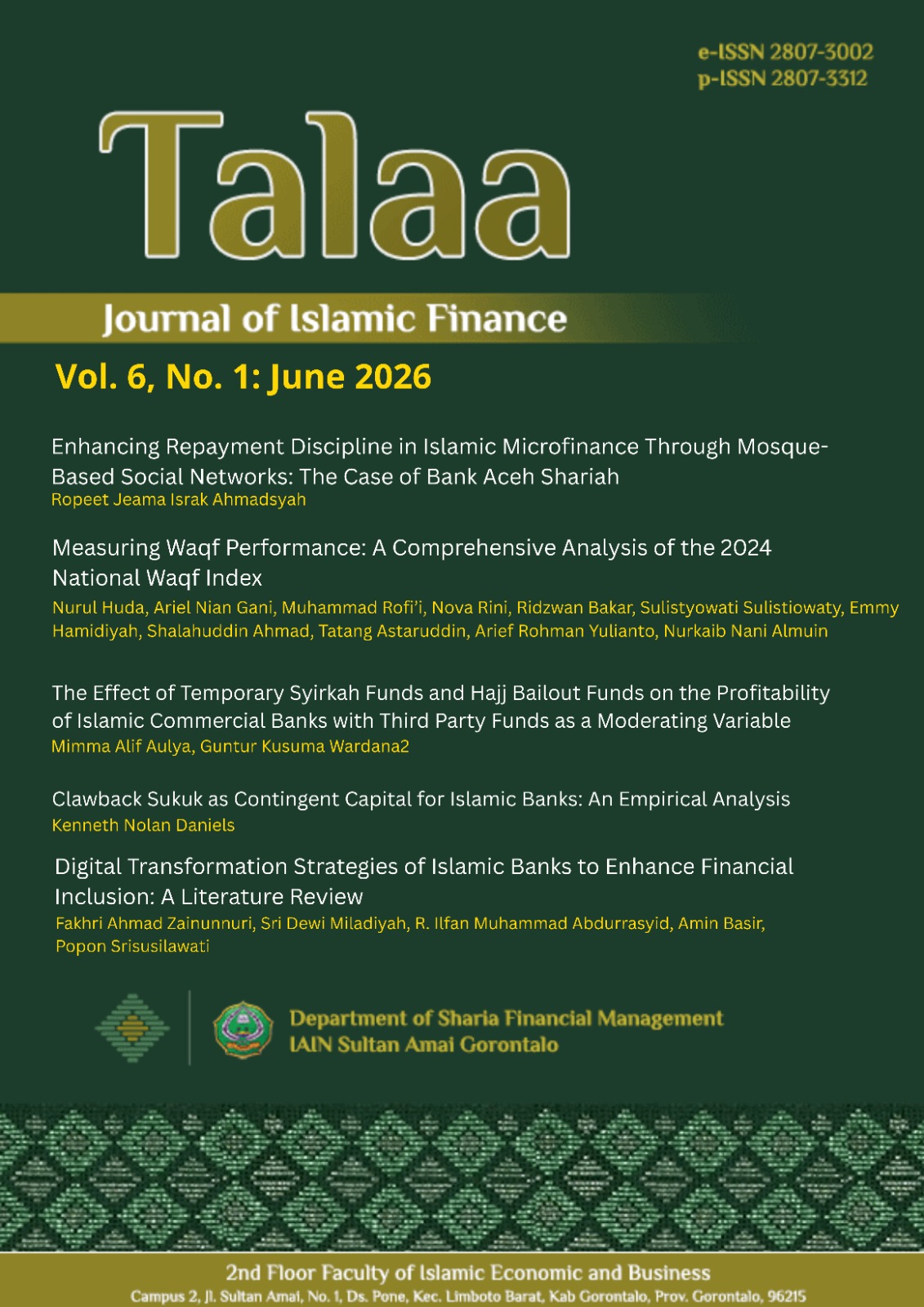
Measuring Waqf Performance: A Comprehensive Analysis of the 2024 National Waqf Index
DOI:
https://doi.org/10.54045/talaa.v6i1.808Keywords:
Waqf, National Waqf Index, Waqf performanceAbstract
Waqf plays a strategic role in building social welfare and supporting national development, but its management in Indonesia still faces challenges of disparity between regions. The National Waqf Index (IWN) serves as a quantitative instrument to systematically and objectively measure the performance of the waqf ecosystem in 34 Indonesian provinces. This study examines the 2024 IWN based on six main pillars: regulations, institutions, processes, systems, outcomes, and impacts, using the Multi-stage Weighted Index method and primary and secondary data from various official sources. The results indicate that the greatest strength of national waqf lies in the regulatory and institutional aspects, with provinces such as Riau, Aceh, and West Kalimantan standing out. However, the process and outcome aspects show the lowest scores nationally, indicating a gap between structural readiness and implementation effectiveness. These findings emphasize the need for human resource capacity building, digital transformation, cross-sectoral approaches, and affirmative interventions in disadvantaged regions to ensure the significant contribution of waqf to sustainable development goals.
References
Abd Jalil, M. I., Yahya, S., & Allah Pitchay, A. (2019). Building committed Waqif: the role of information disclosure. Journal of Islamic Accounting and Business Research, 10(2), 185-215.
Ali, K. M., & Kassim, S. (2020). Waqf forest: How waqf can play a role in forest preservation and SDGs achievement. Etikonomi, 19(2), 349-364.
Ascarya, A. (2022). The role of Islamic social finance during Covid-19 pandemic in Indonesia’s economic recovery. International Journal of Islamic and Middle Eastern Finance and Management, 15(2), 386-405.
Ayub, M., Khan, K., Khan, M., & Ismail, M. (2024). Waqf for accelerating socioeconomic development: a proposed model with focus on Pakistan. Qualitative Research in Financial Markets, 16(5), 937-961.
Herindar, E., & Rusydiana, A. S. (2021). The measuring efficiency of waqf fund. Al-Awqaf: Jurnal Wakaf Dan Ekonomi Islam, 14(2), 107-122.
Huda, N., Trianto, B., & Maskuroh, N. (2025). Intention to donate in green waqf among Muslim community: Indonesian case. Journal of Islamic Marketing, 16(3), 736-758.
Johari, F., Alias, M. H., Shukor, S. A., Abd Wahab, K., Aziz, M. R. A., Ahmad, N., ... & Ibrahim, P. (2015). FACTORS THAT INFLUENCE REPEAT CONTRIBUTION OF CASH WAQF IN ISLAMIC PHILANTHROPY. Malaysian accounting review, 14(2).
Kader, S. Z. S. A., & Mohamad, N. A. (2019). Creating security to finance waqf property development in Malaysia: issues and solutions. In Emerging Issues in Islamic Finance Law and Practice in Malaysia (pp. 53-68). Emerald Publishing Limited.
Kasri, R. A., & Ramli, U. H. (2019). Why do Indonesian Muslims donate through mosques? A theory of planned behaviour approach. International Journal of Islamic and Middle Eastern Finance and Management, 12(5), 663-679.
Lamido, A. A., & Haneef, M. A. (2021). Shifting the paradigms in waqf economics: towards renewed focus on socioeconomic development. Islamic Economic Studies, 29(1), 18-32.
Masrizal, M., Huda, N., Harahap, A., Trianto, B., & Sabiu, T. T. (2023). Investigating the determinants of cash waqf intention: an insight from Muslims in Indonesia. Journal of Islamic Monetary Economics and Finance, 9(1), 17-38.
Maulana, A. Y. (2024). Optimizing the Utilization of Zakat and Waqf for Economic and Social Empowerment of the Ummah. E-INVESTA: Jurnal Rumpun Ilmu Ekonomi dan Bisnis Islam, 1(2), 66-77.
Qoyum, A., & Fauziyyah, N. E. (2019). The halal aspect and Islamic financing among micro, small, and medium enterpises (MSMEs) in Yogyakarta: does Berkah matter?. Journal of Islamic Monetary Economics and Finance, 5(1), 215-236.
Rizal, H., & Amin, H. (2017). Perceived ihsan, Islamic egalitarianism and Islamic religiosity towards charitable giving of cash waqf. Journal of Islamic Marketing, 8(4), 669-685.
Setiawan, N. (2024). Pengaruh Good Corporate Governance terhadap Kinerja Lembaga Wakaf di Indonesia. Journal of Islamic Finance and Syariah Banking, 2(1), 67-75.
Setyomurni, T. A., & Nashirudin, M. (2023). Analysis of the cash waqf linked sukuk (CWLS) model As an instrument of post covid-19 national economic recovery. Islamic Banking: Jurnal Pemikiran Dan Pengembangan Perbankan Syariah, 9(1), 167-184.
Sukmana, R. (2020). Critical assessment of Islamic endowment funds (Waqf) literature: lesson for government and future directions. Heliyon, 6(10).
Sukmana,R.,Sholihin, M.,Beik,I.S., Lestari, Y.D., Indrawan, I.W. and Ajija, S.R. (2021), National waqf index: a measurement for waqf performance, (BWPSNo1/PKTD/BWI/III/2021; BWI Working Paper Series, Issue, 1).
Sukmana, R., Trianto, B., & Zaimsyah, A. M. (2023). Determinant factor of crowdfunders’ behavior in using crowdfunding waqf model in Indonesia: two competing models. Journal of Islamic Marketing, 14(7), 1793-1816.
Usman, H., Mulia, D., Chairy, C., & Widowati, N. (2022). Integrating trust, religiosity and image into technology acceptance model: the case of the Islamic philanthropy in Indonesia. Journal of Islamic Marketing, 13(2), 381-409.
Uula, M. M. (2022). Productivity of Waqf Funds in Indonesia: A Malmquist Index Approach on Selected Philanthropic Institutions. International Journal of Waqf, 2(1).
Additional Files
Published
How to Cite
Issue
Section
License
Copyright (c) 2026 Nurul Huda, Ariel Nian Gani, Muhammad Rofi'i, Nova Rini, Sulistyowati Sulistyowati, Emmy Hamidiyah, Shalahuddin Ahmad, Tatang Astaruddin, Arief Rohman Yulianto, Nurkaib Nurkaib, Nani Almuin

This work is licensed under a Creative Commons Attribution-ShareAlike 4.0 International License.


.png)


