
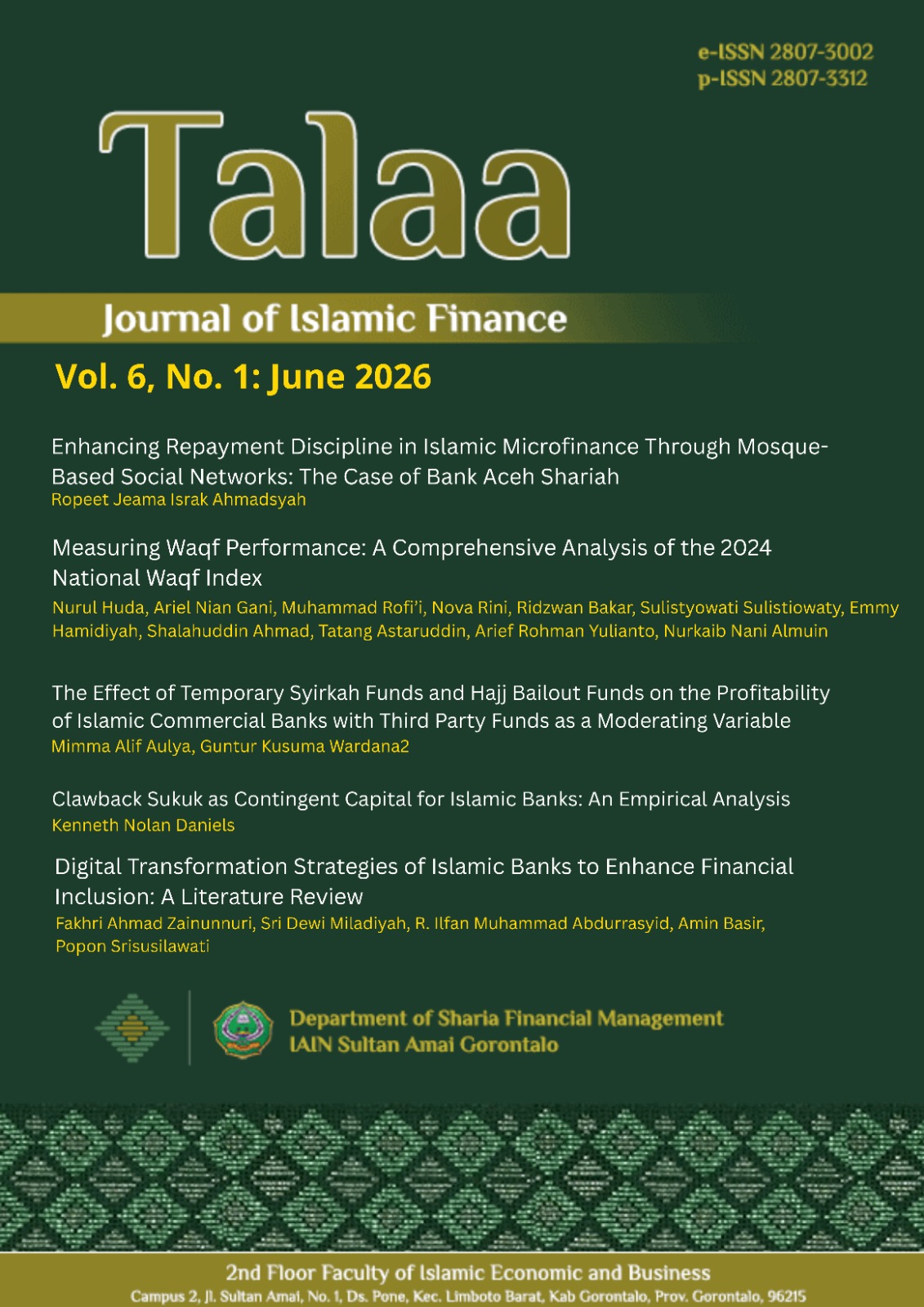
Digital Transformation Strategies of Islamic Banks to Enhance Financial Inclusion: A Literature Review
DOI:
https://doi.org/10.54045/talaa.v6i1.804Keywords:
Digitalization, Digital Literacy, Halal Fintech, Islamic Financial Inclusion, Maqashid ShariahAbstract
This study examines the challenge of low Islamic financial inclusion in Indonesia despite the growth of digital financial services and Islamic financial literacy. Although digitalization has expanded access to financial services, Islamic banks still face difficulties in translating technological advancement into broader and sustainable Sharia-compliant inclusion. This condition highlights the need for an integrated digital transformation strategy that aligns organizational capabilities with user acceptance within the Islamic finance framework. Using a qualitative literature review of academic studies and institutional reports, this study analyzes digitalization strategies in Islamic banking. The findings show that Islamic banking applications, collaboration with halal fintech, strengthened technological infrastructure, and maqashid sharia-based product innovation increase the adoption of Islamic financial services. Theoretically, this study integrates the Technology Acceptance Model and Dynamic Capabilities Theory to explain how organizational readiness and user perceptions jointly support digital transformation. The study confirms that digitalization can accelerate Islamic financial inclusion when aligned with Sharia-based values.
References
Agustiyani, V. P., Renaldo, R., & Baza, I. (2025). Inovasi Teknologi Keuangan Syariah Melalui Fintech Syariah, Digitalisasi Layanan Dan Crowdfunding Halal Di Era Digital (Studi Kasus Di Bank Riau Kepri Syariah Provinsi Riau). Journal Of Accounting And Finance Management, 6(3), 1569–1580.
Babajide, A. A., Adegboye, F. B., & Omankhanlen, A. E. (2015). Financial inclusion and economic growth in Nigeria. International Journal of Economics and Financial Issues, 5(3), 629–637. https://doi.org/10.38157/business-perspective-review.v2i2.149
Bintari, V. I., Kusnandar, D. L., Zahra, Q. S. A., Hamzah, R. A., Aisyah, I., Agisni, S., Agustin, E., & Aditya, M. F. (2024). Literasi Keuangan Digital Syariah Untuk Generasi Alpha di MTs Manarul Huda Kota Tasikmalaya. Abdimas Galuh, 6(2), 1615–1625. https://doi.org/10.25157/ag.v6i2.15422
Cahyadin, M., Sarmidi, T., & Nurrachma, E. A. (2020). The Readiness of Islamic Banking in Indonesia to Implement Digital and Green Banking. Jurnal Ekonomi Pembangunan: Kajian Masalah Ekonomi Dan Pembangunan, 20(2), 176–192. https://doi.org/10.23917/jep.v20i2.6757
Desky, H., & Maulina, I. (2022). Digital transformation in Islamic banking. International Journal of Multidisciplinary Research and Analysis, 5(12), 3616–3622.
Dz., A. S. (2018). Inklusi Keuangan Perbankan Syariah Berbasis Digital-Banking: Optimalisasi dan Tantangan. Al-Amwal : Jurnal Ekonomi Dan Perbankan Syari’ah, 10(1), 63. https://doi.org/10.24235/amwal.v10i1.2813
Fitria, T. N. (2025). Islamic Banking Digitalization: Challenges and Opportunities in the Era of Industrial Revolution 4.0. Jurnal Ilmiah Ekonomi Islam, 11(1).
Hamzah, A. (2019). Literasi Keuangan Dan Inklusi Keuangan Syariah Di Kalangan Tenaga Pendidik Kabupaten Kuningan. Jurnal Akuntansi Dan Keuangan Islam, 7(2), 175–187.
Harahap, D., Afandi, A., & Siregar, T. M. (2023). THE ISLAMIC BANKING CUSTOMERS’INTENTION TO USE DIGITAL BANKING SERVICES: AN INDONESIAN STUDY. Journal of Islamic Monetary Economics and Finance, 9(3), 533–558.
Hasanah, Nor. Sayuti, M., N., & Lisnawati. (2024). Optimalisasi Regulasi Perbankan Syariah oleh Bank Indonesia dan Otoritas Jasa Keuangan dalam Akselerasi Transformasi Digital. Jurnal Manajemen Terapan Keuangan (Menkeu), 13(3), 709-723.
Hildawati. Sono, M., G., & Pahrijal R. (2025). The Effect of Employee Digital Competencies, Technology Infrastructure, and Local Government Support on the Effectiveness of Islamic Banking Digitalization in Bandung City. West Science Interdisciplinary Studies, 3(5), 876-886.
Ichsan, M., Fitriyanti, F., Setiorini, K. R., & Al-Qudah, A. M. (2024). Digitalization of Islamic banking in Indonesia: Justification and compliance to sharia principles. Jurnal Media Hukum, 31(2), 244–261.
Kasri, R. A., Indrastomo, B. S., Hendranastiti, N. D., & Prasetyo, M. B. (2022). Digital payment and banking stability in emerging economy with dual banking system. Heliyon, 8(11), e11198. https://doi.org/10.1016/j.heliyon.2022.e11198
Kholidah, N., Arifiyanto, M., Subowo, E., & Pambuko, Z. B. (2023). Factors Influencing the Interest in Using Sharia Digital Banking Applications in Indonesia. Cakrawala: Jurnal Studi Islam, 18(2), 87–102.
Khusna, T., Fransiska, M., Karimah, N. A., & Arwani, A. (2025). Peran Big Data Analytics Dalam Meningkatkan Transparansi Laporan Keuangan Syariah. Sahmiyya: Jurnal Ekonomi Dan Bisnis, 13–26.
Midu, M., & Yusuf, S. D. (2024). Optimalisasi Peran Bank Syariah Dalam Mendukung Inklusi Keuangan Syariah Di Indonesia. Journal of Innovation Research and Knowledge, 4(7), 4581–4592.
Nst, I. T. A., & Nasution, S. (2024). Digital and Non-Digital Services Influence on Costumers Satisfaction Through Syariah Bank Transactions. Al-Masharif: Jurnal Ilmu Ekonomi Dan Keislaman, 12(1), 29–47. https://doi.org/10.24952/masharif.v12i1.11022
Nurfalah, I., & Rusydiana, A. S. (2019a). Digitalisasi Keuangan Syariah Menuju Keuangan Inklusif: Kerangka Maqashid Syariah. Ekspansi: Jurnal Ekonomi, Keuangan, Perbankan Dan Akuntansi, 11(1), 55. https://doi.org/10.35313/ekspansi.v11i1.1205
Nurfalah, I., & Rusydiana, A. S. (2019b). Digitalisasi keuangan syariah menuju keuangan inklusif: Kerangka maqashid syariah. Ekspansi: Jurnal Ekonomi, Keuangan, Perbankan, Dan Akuntansi, 11(1), 55–76.
Qudah, H., Malahim, S., Airout, R., Alomari, M., Hamour, A. A., & Alqudah, M. (2023). Islamic finance in the era of financial technology: A bibliometric review of future trends. International Journal of Financial Studies, 11(2), 76.
Rahma, N., & Sofyani, H. (2024). The influence of islamic banking digital service quality on intention to continue using islamic banking: A case of Indonesia. Journal of Accounting and Investment, 25(1), 269–288. https://doi.org/10.18196/jai.v25i1.18841
Rahmawati, L. H., Rabbani, A., & Latifa, U. (2025). Pengaruh Literasi Keuangan Syariah, Religiusitas, Inklusi Keuangan Syariah, Layanan Digital M-Banking: Studi Kasus Nasabah Bsi Bandar Lampung Periode 2020–2024. MAMEN: Jurnal Manajemen, 4(2), 158–170.
Rajib, M. M. (2025). IMPLEMENTATION OF DYNAMIC CAPABILITIES TO ADDRESS DIGITAL TRANSFORMATION AND ENHANCE INNOVATION IN ISLAMIC MICROFINANCE INSTITUTIONS. ResearchGate. https://doi.org/10.56293/IJMSSSR.2025.5540
Sudi, D., M. (2025). Islamic Bank Strategy in Facing Competition in The Era of Digitalization. Nomico Journal, 2(3), 21-28.
Sujud, F. A. (2021). Inisiasi Otoritas Jasa Keuangan Kediri Dalam Meningkatkan Literasi Dan Inklusi Keuangan Syariah Masyarakat Kediri. Jurnal Tanbih, 1(April), 67–87.
Teece, D. J., Pisano, G., & Shuen, A. (1997). Dynamic capabilities and strategic management. Strategic Management Journal, 18(7), 509–533.
Hasbi, M. Z. N., Munajat, M., & Qoyum, A. (2023). Human Development Index from the Islamic Perspective: Roles of Taxation, Zakah, and Health and Education Expenditures. Jurnal Ekonomi Malaysia, 57(1), –. http://dx.doi.org/10.17576/JEM-2023-5701-08
Sunandar, A. (2024, September 5). BSI modernizes for growth with Oracle Autonomous Database. https://www.oracle.com/customers/bsi/
Bank Indonesia. (2025). Retrieved from www.bi.go.id
Consultative Group to Assist the Poor. (2025). CGAP : Transforming Lives with Financial Inclusion. Retrieved from www.cgap.org
Otoritas Jasa Keuangan. (2025). Siaran Pers Bersama: Indeks Literasi dan Inklusi Keuangan Masyarakat Meningkat, OJK dan BPS Umumkan Hasil Survei Nasional Literasi Dan Inklusi Keuangan (SNLIK) Tahun 2025. Retrieved from https://ojk.go.id/id/berita-dan-kegiatan/siaran-pers/Pages/OJK-dan-BPS-Umumkan-Hasil-Survei-Nasional-Literasi-Dan-Inklusi-Keuangan-SNLIK-Tahun-2025
Hannany, Z., & Rosdiana, R. (2024, August 6). BSI Mobile as Leading Agent for Increasing Digital Penetration and Integrated Financial Services. Retrieved from Idnfinancials.Com. https://www.idnfinancials.com/news/50524/bsi-mobile-as-leading-agent-for-increasing-digital-penetration-and-integrated-financial-services
Additional Files
Published
How to Cite
Issue
Section
License
Copyright (c) 2026 Fakhri Ahmad Zainunnuri, Sri Dewi Miladiyah, R. Ilfan Muhammad Abdurrasyid, Amin Basir, Popon Srisusilawati

This work is licensed under a Creative Commons Attribution-ShareAlike 4.0 International License.


.png)


