
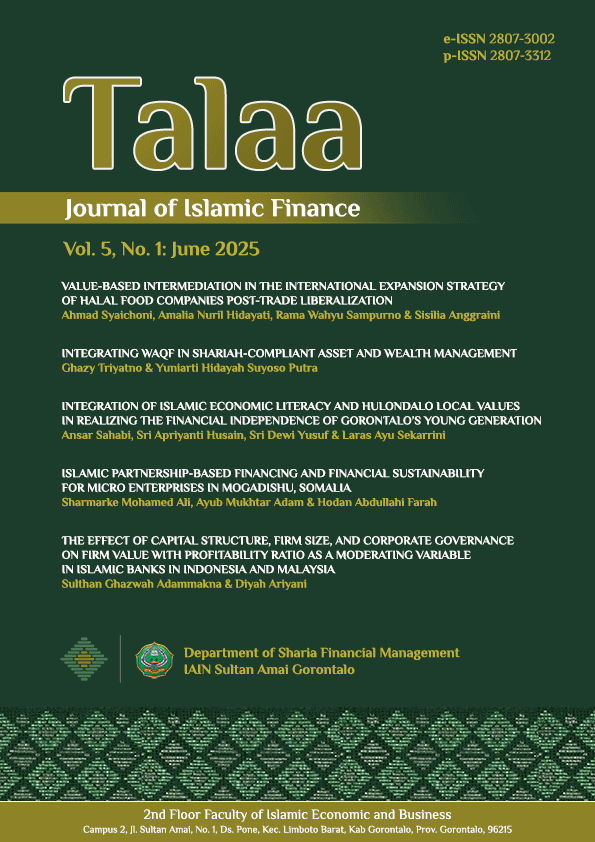
Value-Based Intermediation in the International Expansion Strategy of Halal Food Companies Post-Trade Liberalization
DOI:
https://doi.org/10.54045/talaa.v5i1.777Keywords:
Value-based Intermediation, Halal Food, Expansion Strategy, Halal ComplianceAbstract
Trade liberalization has reshaped the competitive landscape of Indonesia’s processed food industry, including halal food companies that must navigate market expansion while maintaining Shariah compliance. This study analyzes how halal food firms integrate the Value-Based Intermediation (VBI) framework into their international expansion strategies following tariff reductions and the removal of non-tariff barriers. Utilizing a mixed-method approach—combining quantitative analysis of trade and investment data (BPS and UN Comtrade) with qualitative case studies of Indofood and Mayora—the research reveals that firms are not solely pursuing economic efficiency, but also embedding Islamic ethical values such as social sustainability, local farmer empowerment, and halal assurance into their strategies. Key initiatives include the establishment of halal compliance units, alignment with Shariah-compliant financing, and the implementation of risk governance frameworks inspired by maqashid al-shariah. The findings confirm that VBI can serve as an effective strategic model to guide halal food companies in balancing global trade opportunities with their religious and ethical obligations, thereby enhancing both competitiveness and sustainability.
References
Al-Fadhat, F. (2019). The Rise of Indonesian Conglomerates: Capital Expansion and Regional Alliance. In The Rise of International Capital (pp. 127–171). Springer Singapore. https://doi.org/10.1007/978-981-13-3191-6_6
Bhattarai, K. (2016). Welfare and Distributional Impacts of Financial Liberalization in an Open Economy: Lessons from a Multi-Sectoral Dynamic CGE Model for Nepal. International Business Research, 10(1), 181. https://doi.org/10.5539/ibr.v10n1p181
Chelliah, S., & Huoy Lee, M. (2020). The Moderating Role of Government Support on Food Processing SME’s Internal Factors and the Impact on Export Performance. International Journal of Asian Social Science, 10(12), 730–745. https://doi.org/10.18488/journal.1.2020.1012.730.745
Creswell, J. W., & Poth, C. N.. (2018). Qualitative inquiry and research design. SAGE.
Dierwechter, Y. (2017). Methodology: Mixed-Methods Research Design (pp. 63–71). https://doi.org/10.1007/978-3-319-54448-9_4
Erlanitasari, Y., Rahmanto, A., & Wijaya, M. (2020). Digital economic literacy micro, small, and medium enterprises (SMES) go online. Informasi, 49(2), 145–156. https://doi.org/10.21831/informasi.v49i2.27827
Faradilla, C., Zulkarnain, Z., & Bagio, B. (2022). ANALYSIS OF ASPECTS OF FOOD SECURITY: A STRATEGIC ANALYSIS OF APPROACH TO SUSTAINABLE FOOD CONSUMPTION PATTERNS AS AN EFFORT TO REALIZE FOOD POLICY IN INDONESIA. International Journal of Economic, Business, Accounting, Agriculture Management and Sharia Administration (IJEBAS), 2(4), 601–610. https://doi.org/10.54443/ijebas.v2i4.399
Hossain, S. M. (2011). Liberalizing Agriculture by OECD Countries: Welfare, Growth and Distributional Impact in Developing Countries. International Journal of Economics and Finance, 3(3). https://doi.org/10.5539/ijef.v3n3p167
Hülsmann, M., Grapp, J., & Li, Y. (2008). Strategic adaptivity in global supply chains—Competitive advantage by autonomous cooperation. International Journal of Production Economics, 114(1), 14–26. https://doi.org/10.1016/j.ijpe.2007.09.009
Ide, T. (2009). HOW TO RECTIFY UNFAIR TRADE PRACTICES AND TO ESTABLISH APPROPRIATE SUPPLY CHAINS AND BETTER BUSINESS CULTURE UNDER THE GLOBAL MARKET ECONOMY. Pacific Economic Review, 14(5), 612–621. https://doi.org/10.1111/j.1468-0106.2009.00475.x
Isventina, I., Nuryartono, N., & Hutagaol, M. P. (2018). ANALISIS DAYA SAING SEKTOR INDUSTRI PRIORITAS INDONESIA DALAM MENGHADAPI PASAR ASEAN. JURNAL EKONOMI DAN KEBIJAKAN PEMBANGUNAN, 4(1), 71–93. https://doi.org/10.29244/jekp.4.1.2015.71-93
John W. Creswell. (2014). Research Design: Qualitative, Quantitative, and Mixed Methods Approaches (4th ed.). Sage Publications.
Kιrcι, M., & Seifert, R. (2015). Dynamic Capabilities in Sustainable Supply Chain Management: A Theoretical Framework. Supply Chain Forum: An International Journal, 16(4), 2–15. https://doi.org/10.1080/16258312.2015.11728690
Larsen, F. (2017). Overview of Liberalization. In Energy Branding (pp. 49–63). Springer International Publishing. https://doi.org/10.1007/978-3-319-57198-0_3
Lauras, M., Lamothe, J., Benaben, F., Andres, B., & Poler, R. (2015). Towards an Agile and Collaborative Platform for Managing Supply Chain Uncertainties (pp. 64–72). https://doi.org/10.1007/978-3-662-47157-9_6
Li, X., & Chen, F. (2021). Impact of Logistics Development on Economic Growth: An Empirical Research from Guangdong Province in China. Complexity, 2021(1). https://doi.org/10.1155/2021/9950935
Mahpour, A., Farzin, I., Baghestani, A., Ashouri, S., Javadi, Z., & Asgari, L. (2023). Modeling the impact of logistic performance, economic features, and demographic factors of countries on the seaborne trade. The Asian Journal of Shipping and Logistics, 39(2), 60–66. https://doi.org/10.1016/j.ajsl.2023.02.003
Makutsenia, E. P., & Zapolsky, M. I. (2019). Theoretical approaches for the improvement of foreign trade relations in the agri-food sector in the context of increased competition in the world market. Proceedings of the National Academy of Sciences of Belarus. Agrarian Series, 57(4), 391–405. https://doi.org/10.29235/1817-7204-2019-57-4-391-405
Melnychuk, N. (2022). THE ROLE OF THE PRICING STRATEGY IN THE DEVELOPMENT OF BEER INDUSTRY ENTERPRISES. Scientific Bulletin of the International Association of Scientists. Series: Economy, Management, Security, Technologies, 1(1). https://doi.org/10.56197/2786-5827/2022-1-1-4
Riyani, R., Darsono, D., & Ferichani, M. (2018). Analisis Permintaan Ekspor Komoditas Pertanian Indonesia oleh Pasar Tiongkok. AGRARIS: Journal of Agribusiness and Rural Development Research, 4(2). https://doi.org/10.18196/agr.4267
Sofjan, M. (2017). International Journal of Economics and Financial Issues: The Effect of Liberalization on Export-Import in Indonesia. International Journal of Economics and Financial Issues, 7(2), 672–676. http:www.econjournals.com
Supriati, D., Ramaditya, M., & Wardhana, N. (2019). Examining the Impact of Leverage and Liquidity on Corporate Performance (A Case Study on Food and Beverage Companies in Indonesia). Proceedings of the 5th Annual International Conference on Accounting Research (AICAR 2018). https://doi.org/10.2991/aicar-18.2019.32
Tien, T. B., & Van, H. T. (2020). Assessing economic development through trade relations and educational markets integration (the case of Vietnam within ACFTA). E3S Web of Conferences, 210, 13016. https://doi.org/10.1051/e3sconf/202021013016
Wardani, M. A., Mulatsih, S., & Rindayati, W. (2018). Competitiveness and Factors Affecting the Indonesian Food Industry’s Export to the Regional Comprehensive Economic Partnership. ETIKONOMI, 17(2), 185–198. https://doi.org/10.15408/etk.v17i2.7239
Yuliawati, L. (2017). Analisis Struktur Perilaku dan Kinerja Industri Makanan dan Minuman di Indonesia. Journal Ecodemica, 1(2), 266–273.
Additional Files
Published
How to Cite
Issue
Section
License
Copyright (c) 2025 Ahmad Syaichoni, Amalia Nuril Hidayati, Rama Wahyu Sampurno, Sisilia Anggraini

This work is licensed under a Creative Commons Attribution-ShareAlike 4.0 International License.


.png)


